Regulated entities and their authorised users have responsibilities under the New Vehicle Efficiency Standard Act 2024(Opens in a new tab/window) (NVES Act).
Regulated entities
You are a regulated entity if you are a vehicle manufacturer, supplier or importer that holds a vehicle type approval for an NVES covered vehicle and enters it on the Register of Approved Vehicles(Opens in a new tab/window) (RAV) for the first time.
A vehicle type approval holder is the individual or company granted permission to provide a specific type of vehicle to the Australian market under a vehicle type approval(Opens in a new tab/window) as per the Road Vehicle Standards Act 2018(Opens in a new tab/window) (RVSA).
You are not a regulated entity if you:
- only supply vehicles
- as a second stage manufacturer
- under the concessional RAV entry pathway
- with a gross vehicle mass (GVM) greater than 4.5 tonnes
- within a vehicle category that is not covered by the NVES (for example, motorbikes, small omnibuses, tractors).
- sell or distribute new or used vehicles but are not a vehicle type approval holder (for example, dealerships)
- are an Australian consumer purchasing a new or used vehicle.
Covered vehicles
The NVES applies to covered vehicles with a GVM up to 4.5 tonnes. Covered vehicles are classified under 2 types:
- Type 1 vehicles: new light passenger vehicles such as cars, sport utility vehicles (SUVs) or light off-road vehicles.
- Type 2 vehicles: new light commercial vehicles such as utility vehicles (utes) or vans and heavy off-road vehicles.
The following table describes each vehicle type in accordance with division 2 of the NVES Act.
| Vehicle type | Description |
|---|---|
| Type 1 |
|
| Type 2 |
|
Emissions targets
Emissions targets are calculated for each vehicle type based on headline limits for that year and vehicle type adjusted for vehicle mass.
A headline limit is a number representing grams of CO2 per kilometre for a Type 1 or a Type 2 vehicle. They are lowered each year, providing an incentive for regulated entities to lower the emissions of their fleets year on year.
Emissions targets are used to calculate an entity’s interim emissions value (IEV).
The Minister for Transport set the emissions targets for Type 1 and Type 2 vehicles from 2025 to 2029 as outlined in the following table.
| Year | Type 1 vehicles | Type 2 vehicles |
|---|---|---|
| 2025 | 141 | 210 |
| 2026 | 117 | 180 |
| 2027 | 92 | 150 |
| 2028 | 68 | 122 |
| 2029 | 58 | 110 |
Exempt vehicles
Vehicles with a GVM over 3.5 t are currently exempt and are not covered by the NVES, as set out by the NVES Determination 2024(Opens in a new tab/window).
How to comply
Submit correct NVES data
Regulated entities must submit NVES-specific data on the RAV for all covered vehicles.
Entry on the RAV is an administrative step that must be completed by all vehicle type approval holders before they provide an approved road vehicle to the Australian market for the first time.
Under the RVSA, regulated entities must make sure all data, including NVES-specific data entered on the RAV, is true and correct.
What NVES data must be entered?
- NVES vehicle type: the type (1 or 2) of vehicle as defined above and in division 2 of the NVES Act.
- Carbon dioxide (CO2) emissions: the vehicle’s CO2 emissions measured in grams of carbon dioxide per kilometre. It is calculated based on the national road vehicle standard that applies to the vehicle.
- Mass in running order (MIRO): the mass of the vehicle in kilograms, including all fluids, standard equipment and 75 kg for the mass of the driver.
If a vehicle is entered on the RAV as a chassis-cab with no bodywork fitted, the vehicle’s MIRO is either the:- highest MIRO value declared in the supporting information underpinning the CO2 dioxide emissions value declared for the chassis-cab by the manufacturer
- MIRO value of the chassis-cab without bodywork fitted plus the average mass of the bodywork options offered for fitment to the vehicle by the vehicle’s manufacturer
- MIRO value of the chassis-cab without bodywork fitted plus the maximum area of the body recommended for fitment to the vehicle by the vehicle’s manufacturer (in square metres to one decimal place) multiplied by 50 kg.
- Rated towing capacity (RTC): the maximum towing mass in kilograms as specified by the vehicle’s manufacturer. RTC is only applicable to MC category vehicles.
Guidance: Submitting correct MIRO and CO2 values
We have developed the following guidance to help regulated entities submit correct MIRO and CO2 values and comply with requirements under the NVES.
Submitting accurate MIRO and CO2 values is essential because they used to calculate an entity’s performance under the NVES. These values affect the number of NVES units issued or the liability an entity may accrue if it does not beat the target.
Access guidance for:
More information
The Guide to the Register of Approved Vehicles(Opens in a new tab/window) provides more information on why and how to submit vehicles.
Interim and final emissions values
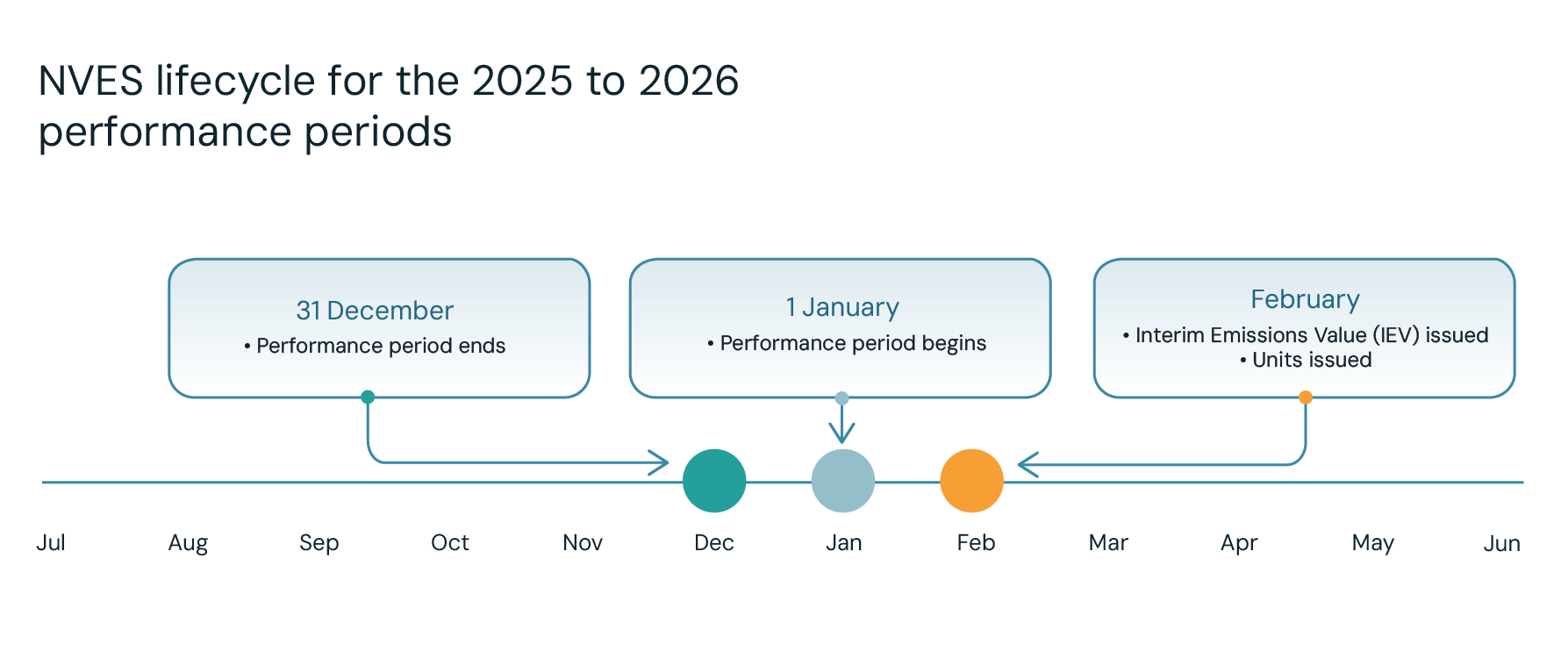
An interim emissions value (IEV) is a measure of how a regulated entity has performed against its emissions targets for a performance period.
A final emissions value (FEV) is issued 2 years after the IEV for a given performance period.
Regulated entities should make sure their FEV is zero or less. If the FEV is not equal to zero or less, the entity may be issued an infringement notice. To get to zero, prior to the FEV being issued, an entity has 2 years to address their balance by extinguishing units against their IEV.
Learn more at calculating IEVs, FEVs and issuing units.
Performance periods
Each performance period begins on 1 January and ends on 31 December of that year.
The exception to this rule was for the 2025 performance period, when it began on 1 July 2025 and ended on 31 December 2025. We published the 2025 performance period results on 18 February 2026.